Showing posts with label city paper. Show all posts

Friday, June 8, 2012

Timothy App's Threshold @ Goya Contemporary


Within our small arts community, we are excited when we get to cheer on hard-working, talented individuals who make Baltimore a diverse and vibrant city. Annual art awards and an exciting DIY art scene provide regular opportunities to look in on the new, host the traveling, or experience the fleeting with enthusiasm and camaraderie. There is, however, a special kind of love reserved for those mid-career artists who have given their lives to Baltimore, contributing tirelessly to its intellectual and artistic landscape. Painter and Maryland Institute College of Art professor Timothy App has earned this sort of reverence through a consistent artistic and academic career, devotion to his students and community, and producing impressive bodies of work that continue to develop within the confines of the canvas and his super-flat, glazed surfaces.
Threshold, App’s current solo exhibition at Goya Contemporary, enjoyed a crowded and successful opening, as anticipated, but is undoubtedly best as a solitary viewing experience. Consisting of eight new, large-scale paintings and a handful of works on paper, Threshold is a quiet, meditative exhibition that forgoes the acute angles of his recent paintings in favor of rectangular forms and a comfortable symmetry. App’s subtle hues of muted grays, greens, and muffled purples hug expansive, central planes of black and white, which the artist refers to as “portals.” This description is fitting, as the layering and perspective appear to shift as viewers stand before them. These slight vibrations recall Mark Rothko, and the obsessively neat surfaces find company with finish-fetish artists like John McCracken.
In the canvas paintings, the compositions fit together like pieces of a puzzle. Each colored plane ends with a crisp lip where tape helped dam the layers of paint in their working stages. Slight shadows cast by these ridges play a visual trickery on some viewers, making them believe the paintings contain collaged elements, neatly adhered into their perfect geometry. App’s laborious selection of color shades, a quality of his work best appreciated in person, gives each painting a transparent and mysterious quality. Like Ad Reinhardt’s black paintings made up of subtle variations of color, App’s ambiguous grays and tans at the edge of the compositions look like raw linens upon first glance, but are actually subtle hues painted on canvas. The thin evenness of App’s glazing technique allows the texture of the fabric to come through.
Goya Contemporary Director Amy Eva Raehse explains that these new works are in dialogue with a number of App’s older series, including the homage paintings and vessels, which the artist recently revisited in preparation for a 2013 retrospective at the Katzen Museum in Washington, D.C. His oeuvre of the past decade shows small shifts in his formalist rigor, a fixation on parallel lines and rectangular forms bending into triangles and angular arrangements. In some works, rounded arcs swoop through otherwise hard-edged arrangements. After re-examining and documenting the older works for the forthcoming catalog that will accompany the Katzen exhibition, App picked up old threads in his work to create the new series. Compositions once again soften into right angles embodying the simultaneous language of a contemporary computer screen, with window-like layering and a modernist sensibility. Emanating a soft, central glow through the play of paint color, many of the pieces seem to refer to digital screens, stages, and Hiroshi Sugimoto’s long-exposure photographs of movie theaters. In particular, “Agora” and “Proscenium” most resemble monolithic projector televisions, with white, squarish planes resting on narrower black rectangles. The suggestion that these screens are off, the stage empty, adds a clever narrative to these otherwise abstract works: the contemporary substitute for meditation and tranquility versus the tranquility that can be achieved through painting.
In its title, Threshold conveys the spiritual and transportive nature of these new works, which are deceptive in their simple compositions. An intangible space opens up in the picture planes, existing for brief moments between colors and shapes and the slight translucence of the acrylic. From a distance it becomes hard to imagine that these works have a human creator, but this illusion dissolves with closer inspection. Slight imperfections, be they small areas of color inconsistency or minute wavers of a line, firmly root these works in the hand and the painting process. While the pieces in Threshold are more pared down than previous series in App’s career, both in composition and color variety, the end results are no less complex.

Wednesday, October 6, 2010

Ben Gest's "Commissure" at the Contemporary Museum


From City Paper:  A couple stands over a shiny wooden counter preparing parts of a meal in the photograph titled “Ben and Dawn.” Ben is looking down at the lump of hamburger meat in his hands, which hovers above a plate that sits at an impossible angle on the countertop. The inconsistent perspective makes the meat look foreign, nauseating. Dawn stands close to Ben chopping vegetables. In her right hand she holds the knife to the side of the diced pieces; her left arm extends an inordinate length, making her appear lopsided, and her left hand lays awkwardly on the cutting board. With a vacant expression on her face, Dawn doesn’t appear present in the activity. Her hair is unfixed, and falls over her left eye. Her dress is brightly patterned, and she isn’t wearing makeup. Ben and Dawn look like they might be getting ready to entertain, but they express no pleasure or excitement. And at its large scale—45 inches by 40 inches—this otherwise ordinary scene becomes uncomfortable, the figures trapped in the close-cropped composition.
The images in Commissure, Chicago-trained photographer Ben Gest’s solo exhibition of digital portraits, are pieced together and manipulated from multiple images of the same subject. In some cases, hundreds of photos are combined to make the final image. As in mannerist paintings, scale, perspective, and focus change slightly across the portraits’ compositions. Body parts are subtly elongated, an extended arm is disproportionately long, a floor appears vertical. The distortions are meant to call attention to the psychological unease and physical discomfort of familial relationships and day-to-day interactions, but they are not particularly jarring and in some cases barely noticeable. The process for creating these works is careful, meticulous, and precise, but the imagery remains cold and often bland.... READ COMPLETE REVIEW HERE

Wednesday, June 24, 2009

A Sculpture Show @ C. Grimaldis Gallery

John Van Alstine
Originally Posted at Citypaper.com
Little Giants
Group show focuses on the smaller works of big names
By Alex Ebstein

A Sculpture Show,
C. Grimaldis Gallery's
2009 manifestation of its annual summer sculpture group show, features the small works of big names. For an exhibition whose bill includes Richard Serra, a gargantuan sculptor both in product and celebrity, the work is diminutive, and at times delicate. Some of the pieces in this exhibition look like maquettes for larger pieces, while others are explorations of form and material. Show's eight sculptors, having achieved some recognition for their larger pieces--some of which were seen in last June's Grimaldis @ Area 405--present a domestic-friendly set of works, as well as two dimensional drawings and sketches, which compromise little with the exception of scale.

Richard Serra

Placed front and center in the gallery's window pedestal, John Van Alstine's "Sisyphean Circle (Beijing XVII)" is probably most pleasing piece to imagine as a larger work. A graceful, flat metal ring stands upright from a curved red base. From the inside edge of the ring, a red pigmented steel joint suspends a sharp stone into the circle's center. The composition suggests a constant, impending motion--a guillotine movement of the stone or spinning of the wheel-like ring--while remaining frozen in its potential energy. Begging to be surrounded by action figures at this size, a two-story version of the structure would be awesome and terrifying. Unfortunately, Van Alstine's two other, smaller works--also metal circle/stone pieces--are comparatively static. Crafted from chunkier pieces of metal and welded haphazardly, the illusion of balance is lost.

John Van Alstine
Annette Sauermann provides a visual bridge between the two- and three-dimensional works with her two wall-bound sculptures and a series of three collages. In the past, Sauermann's worked with light, creating large, elaborate architectural installations to emphasize luminescence or to trap the glow of a light source. In a shift toward the two-dimensional, Sauermann's newer work consists of thick, flat concrete slabs fitted with translucent pieces of plexiglass and light filters. While drastically reserved, she continues to address light and architecture, minimally and materially. As if working backward from the room to the wall, it's a short reach from her concrete sculptures to her collage series. Compressing and flattening space and light, her collages on board are also crafted from cement, light filters, and sandpaper.
John Ruppert

While most artists include colorfully and materially consistent pieces--and in the case of Van Alstine, repetitive forms--John Ruppert includes both the most hulking, masculine structure, and alternately the most delicate, petite piece. The vertical, cast-iron shaft "Split Column" is unfeasibly balanced on its narrow point in a circle of black sand. Resembling a splintered tree trunk, Ruppert's organic form is simultaneously precarious and imposing. Ruppert's smaller, white plaster "Phobos #2 (Celestial Bodies Series)" is contrastingly fragile but more comfortably grounded. At just 10 inches high, "Phobos" consists of two slightly imploded blobs; the bottom solid, and the top form a lacey lattice.

John Ruppert, background, Chul-Hyun Ahn Foreground

Chul-Hyun Ahn, whose infinite light/mirror tunnels took a dramatic turn toward diorama at the end of last year, includes two minimal pieces: "Horizon," which is wall mounted, and the free-standing "Well 4." While most works in the exhibition are of souvenir status and would look comfortable in a home, Ahn's pieces veer toward the functional. "Horizon," a glass pane in front of a neon-bordered mirror, casts off enough light to serve as a cool, contemporary lamp, while it wouldn't be much of a stretch to see the round, glass-topped "Well 4" as a coffee table--neither of which is meant to be a slight. Ahn's smaller works remain distinctly recognizable and adaptable to every potential setting, blurring the line between art and design.

Jon Isherwood

The pieces in A Sculpture Show offer a similar impression to viewing the blueprints and architectural models of a building you've already visited. In many cases, the work and planning that goes into the model is more intimate and exciting than the resultant building, which is often taken for granted. These works allow a view into the development, process, and range that each artist has accomplished; a chance to reconsider familiar pieces and the planning involved.


Tuesday, June 2, 2009

Decoy @ Creative Alliance


Originally Posted at Citypaper.com

The Illusionists
Looks can be deceiving in this smart, polished group show

By Alex Ebstein

Decoy, the exhibition currently on view at the Creative Alliance, makes you look twice and question what you see. Each of the art works in this show, curated by Erin Cluley, causes you to waver between its surface attraction and a deeper message, which you reconsider upon each viewing. Visually airy with an array of edgy undertones, Decoy lures you in and dares you to be shallow.

Jenny Mullins' drawings of majestic birds, with their detail and clean stylization, resemble both postage stamps and propaganda posters. In each image, the birds are bound and constricted by rope, or disfigured by belts and sequined, yellow hoods. Dotted with a barrage of arrows and aggressive flag poles, it is uncertain whether the images are supposed to read as victorious or sympathetic. In "Sacrifice to the Economy," a single bird of prey's feathers bulge against bindings, and strings trail out of the composition from the tiny arrows along its back. With its head obscured by a traditional falcon hood--albeit one bespangled with sequins--the bird is either blinded against the violence being acted upon it or made vulnerable by its hooded condition. Verging on satirical illustration, Mullins plays on contemporary American tensions and the constriction of national pride.

Paul Jeanes' oil paintings of lush cloud formations offer the initial impression of photographs taken from an elevated or hovering perspective, and they're hung along the back wall of the exhibition to create such an illusion. The hand and the medium become obvious at a closer range, but the images then reveal hidden details--a flock of birds, a helicopter--invading otherwise pristine cloudscapes. Jeanes' artist's statement claims that the paintings--from his series, "Not to Touch the Earth (1000 Skies for Mies van de Rohe)"--are based on the view from the van de Rohe-designed Highfield House in the Tuscany-Canterbury neighborhood. In a similar celestial study, Jeanes includes a grid of small paintings of the moon. Next to the imposing cloud triptych, the small images, while charming, are relatively unambitious, and the moments captured are less interesting.

Michael Mansfield's two charcoal drawings examine views from space. At their massive scale--100 by 100 inches and 104 by 132 inches, respectively--the drawings appear to be elegant, topographical data charts of remote or imagined islands. Indicating a satellite's perspective and mapping unidentified landmarks by using nodes of varied sizes, the information relayed becomes a pattern of indeterminable possibilities: clusters of people, military units, cell phone towers, McDonald's locations, etc. Mansfield simultaneously celebrates the awe of technology and examines the unease of its potential by letting his viewers fill in the blank as to why such data is being gathered.

Robert Horvath's tantalizingly slick, shiny paintings look like exotic floral still-lifes from afar, but up close they reveal a germ-like, organic structure more akin to a science project. The gaseous bubbling, cell-like structures billow and glow against their stark, black backgrounds. The radiant, bulbous forms have an uneasy hostility, like an unstoppable, alien disease--think The Blob, only prettier--swelling across the paintings' surface. Hanging on either side of Kendra Lee Hebel's "Sugarpus"--a set of three costumes made from resin and hair--Horvath echoes Hebel's more obvious play on the value of beauty.

Hebel's three dresses, worn by white mannequins, directly contrast the clean form of the body with physical anomalies and asks--not so subtly--which is more interesting. The tactile, overpowering dresses, made of synthetic hair and rubber silicon, mimic body hair and growths, while cut and presented like delicate ballet costumes. Worn by live models during the opening, and undoubtedly made more startlingly organic through movement, "Sugarpus" finds exoticism in moles, hair, and cancerous growths.

Decoy is a smart show, successfully drawing parallels and pairing works one might never have considered complementary. Bringing together artists working in a variety of media, size and subject matter, Cluley presents a realized exhibition with an overall message and curatorial statement: Things aren't always what they appear to be. While the exhibition is positively polished, attractive and professional, if you get stuck on the surface, you're missing the point.

Tuesday, April 14, 2009

Photos from Altered States @ Load Of Fun

Posted Originally on the City Paper website
Transmodern, Day Four: Altered States
By Alex Ebstein
Altered States, a satellite Transmodern exhibition and the latest curatorial endeavor by Jamillah James, delivers an impressive--dare-we-say all-star, both local and national--roster of video, installation, and new media artists, with a killer live performance at the opening to boot. Bringing the work of major, contemporary artists--including a video piece by the Providence-based collective Forcefield, which consists of Matt Brinkman, Jim Drain, Ara Peterson, and Leif Goldberg--into the Baltimore and Transmodern spectrum, while simultaneously highlighting local artists working in the same vein, Altered States helps to uphold the level of professionalism that the Transmodern festival has achieved with each year's manifestation.
Though unfortunately limited to the smaller, second-floor gallery at Load of Fun, James more than made due with the space's awkward, hallway layout. Projecting two larger videos and screening additional pieces on television monitors--along with three major installations by Erin Womak, a collaboration between Caitlin Williams and Sarah Milinski, and the New Jedi Order--the space is full without being overcrowded. Cohesive in its overall aesthetic and celebrating the action of making work over the idea of art as product, the exhibition is an intentional throwback to 1960s fringe, communal subcultures. A majority of the included works are collaborative projects, with the pieces by individual artists echoing the idea of a collective ceremony. Womack displays a beautifully eerie series of masks, many of which were seen in her ritual, performance/installation during last year's Transmodern festival, while Jimmy Joe Roche plays the part of a spiritualist in his video.


As a whole, the video work is comprised of experimental forms and ambiguous imagery. Familiar images and symbols lose their recognition and meaning within each strange context. In watching the looping footage melt from one visual reference into the next, a greater narrative is never obvious. EMR's (Matt Bass and Dylan Mira's Extreme Mature Respect) and Forcefield's respective pieces reflect a vague communal or teamwork effort to an indeterminate end, although EMR's repetitious imagery of linking arms arguably climaxes with an unrelated explosion.

Marking the closing of Transmodern and the opening of Altered States, Sunday night's music performances were similarly themed and well-considered. Featuring the indisputably awesome line-up of the Lexie Mountain Boys, Soft Circle, and Ra Khuit Noor (a performance by Erin Womak and Ravi Binning, which exceeded the average attention span by three minutes or so). Perhaps the only blip was the inclusion of New York's Blues Control. Purposefully ambient, the band has the stage presence of an iPod, an uncomfortably sharp contrast to the upbeat energy of its fellow performers.

Despite its satellite location, Altered States pushes the Transmodern envelope and manages to capture its generally uncontainable energy in a gallery exhibition. Perhaps a glimpse into the future of the festival, and certainly a concise and digestible cross-section of the overall, four-day program, Altered States helps to establish this Baltimore institution's art-world relevance and reinforces its infinite potential. Altered States was a one-night-only event, and compelling enough to make us look forward to James' future projects.

Wednesday, December 31, 2008

TEN BEST REASONS FOR ARTISTS TO LIVE IN BALTIMORE, 2008:

TOP TEN
(Compiled by Alex Ebstein of Ten Tigers and Cara Ober of BmoreArt)

1. CASH PRIZES! The new Baker Artist Awards, as well as the newly established Sondheim Prize, awarded annually, means up to $85,000 for a handful of local artists. This is NOT chump change and does establish, especially in times of economic uncertainty, a REAL commitment to artists here in Baltimore (unlike that Station North Tax Bullshit).

The Baker Artist Awards is absolutely free for artists to participate in and encourages an online community for artists living here – a virtual curator's wet dream!

The Sondheim Prize set the tone three years ago, awarding $25,000 to one artist and promoting the work of finalists and semi-finalists in professional exhibitions, as part of Artscape.

2. Free Museums/Free Fall Baltimore: Beginning in 2006 with an $800,000 fund from Baltimore City and County, and having acquired a current list of 20 sponsors, Baltimore residents continue to enjoy free admission to the BMA and Walters Art Museums. Additionally, Free Fall Baltimore organizes free events and workshops involving several of the city's under-attended art centers, including Baltimore Clayworks and Reginald F. Lewis Museum of Maryland African American History & Culture. Having access to international, contemporary and historic artwork free-of-charge is an invaluable resource to students, teachers, aspiring and working artists alike.

3. Gary Kachadourian! We love Gary. A working artist, teacher and Visual Arts Coordinator at Baltimore Office for Promotion and the Arts, the man can't possibly sleep. Organizing city-wide events, reviewing grant proposals, and serving as a constant resource to the arts community, Gary Kachadourian is responsible for some of Baltimore's greatest art assets. From the Current Gallery to beautifying the city (and employing local artists) with the Baltimore Mural Program, Gary is behind the scenes of Baltimore's coolest public art projects.

4. A Rumor of Live/Work Spaces being built by the city! I have no idea where this project is, in terms of being a fantasy or a reality, but rumor has it that the city is funding the construction of loft-style studio spaces on abandoned lots in the city. Other rumors are that 11 Row Homes on the 1600 block of Latrobe St. (between Lanvale & Federal St., just east of Guilford) are now being rehabbed for Artists to not only live in, but also work in. This project is being funded by a private company so it could be bust at this point. However, as real estate prices plummet and the station north arts community grows stronger each day, the price is right and the only people with enough 'vision' and/or crazy to buy or lease these spaces are artists.

Ryan Browning's "Image Guardian" at Gallery Four

5. New and Re-Opened Venues. In 2008, no less than 6 major players emerged or re-opened on Baltimore's cultural venue roster. Two projects (originally) spearheaded by Jason Hughes, The Library and Gallery Four are again holding exhibitions, while The Wind Up Space, The Strand and Echo have begun to establish themselves as enclaves of artistic, theatrical and musical expression in the city. The Hexagon, formerly the Lo-Fi Social Club, continues to showcase young, regional musicians on their stage and artworks in its lounge-like lobby. Baltimore's talents have an ever-expanding outlet for exhibition.

Aaron Henkin and Lisa Morgan of the Signalrin

6. A Supportive Local Media. Baltimore artists are fortunate to have individuals like Bret McCabe, Lisa Morgan, Aaron Henkin and Tom Hall in the local press. Shining a light on many of the deserving exhibitions and art ventures produced in the city, The Signal, Maryland Morning and City Paper help to generate the encouraging buzz needed in the community. Be it an interview with Lisa Morgan, or a CP best-of nod, artists receive a healthy amount of praise and recognition along with some valuable criticism.

Erin Cluley in front of Rene Trevino's mylar sun disc, photo by Cara Ober

7. Erin Cluley. Sure, she is adorable and yes, an artist in her own right, but this year she's been cutting her teeth as a professional curator and we have to say, we're happy with her efforts. Cluley is most often seen behind the scenes at C. Grimaldis Gallery, as the assistant gallery director. We suspect she is at least in part responsible for the tremendous innovations we've seen in the last year from this Baltimore mainstay – especially exhibits like Grimaldis Sculpture at Area 405, as well as her own curatorial projects like, "My ______ Other," "To The Teeth" and "Transitions" all at Creative Alliance, Cluley shows a professionalism and a promise that Baltimore sorely needs.

Photo by Cara Ober

8. NEW ART STORE! The Artist and Craftsman Supply store opened its doors several months ago, next to Joe Squared Pizza on the corner of North Avenue and Howard Street. If it's colorful, funky attitude doesn't win you over, their low prices and huge selection of everything you need will. We hope that their strategic location, next to MICA's graduate studios will be condusive to their success because we like shopping there! Kitty cat stickers and glitter and wooden boxes to paint on? YEAH. This store is part of a small chain of stores based in Maine.

Philippa Hughes in the Washington Post, image by Len Spoden

9. DC ART Collectors! God Bless 'Em. Just a short train ride away, DC has an art scene that is populated not only by artists and curators but these other people called COLLECTORS. These collectors actually PURCHASE work by local emerging artists, sit on panels to brag about their collections, provide tours of their homes and collections, and support LOCAL artists. It is truly amazing. Names like Philip Barlowe, Philippa Hughes, Heather and Tony Podesta, Robert Lehrman, ames Alefantis, Monica Bussolati, Allison Cohen, Melvin L. Hardy, and Dr. Michael Pollack are music to artists ears in DC, and also Baltimore artists who manage to get their work there. You can read Philippa's Hughes' blog, The Adventures of Hoogirl to get an idea of this concept!

Philip Barlow photographed by Max Hirshfeld

Where are the Baltimore collectors? They do exist. At this point, there are a few shining stars and we LOVE you!, but most Baltimore collectors still prefer to buy work for their collections in New York and spots outside of Baltimore. For shame! Local collectors need to step it up and get involved with the homegrown art scene. Panel discussion on collecting, anyone? Just say the word and we'll make it happen.

10. Local Art Blogs. Not that we're trying to pat ourselves on the back or anything, but blogs are an amazing, although under-utilized, promotional tool. Immediately accessing an international audience, Radar Redux, Baltimore Interview, Bmore Art and Ten Tigers are on a mission to bring Baltimore's artists to the world! On a less grand scale, blogs help to consistently promote and document local events and exhibitions, creating permanent, accessible records for artists, curators and art spaces. We're here for you.

Saturday, September 13, 2008

Nice Write-Up


Congratulations to Kari Altmann and Mark Brown (occasional Ten Tigers Contributer) for the awesome write up of their show in the City Paper!
Check out"Web of Guise; Group Show Tackles the Possibilities of The Virtual World," Martin L. Johnson's review of Netmares/Netdreams: here. And if you haven't seen the exhibition, make sure to get down to Current before it closes on the 19th.

Wednesday, July 9, 2008

Because We Love Them

AK SLAUGHTER IN BALTIMORE CITY PAPER:

Shrouded in Simplicity


AK Slaughter's Party Rap Is Just Waiting To Cut You Down

Sam Holden
PLATONIC IDEAL: Emily Slaughter (Left) and Aran Keating Share a Musical Bond.

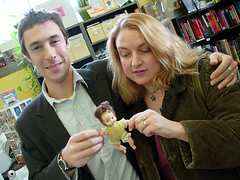
AK Slaughter keeps it simple. It's an idea that the old school-inspired duo of Emily Slaughter and Aran Keating, both 24, keep coming back to when describing their music and, just as much, when they're describing through their music. "Hip-hop is simple/ We show our guts in the bedroom window/ Plus our sound's so simple/ Not too complex," the pair raps in tandem on its song "Mushroom Head."

For Slaughter and Keating, simple doesn't just mean uncluttered beats, though that, too, characterizes their sound. Simplicity also means eschewing gimmicky personas in favor of being themselves. It's reflected in the group's moniker, a blending of their given names, as well as the duo's penchant for addressing each other as Emily and Aran in their songs.

"We're two separate people doing this thing together," Slaughter says. And with A Personal Matter, AK Slaughter is banking on that symbiosis of their two distinct personalities.

With a quick tongue and ready laugh, Slaughter comes off as the more outgoing of the duo. Keating is quieter on all subjects save his love for music; he has a tendency to let his words trail off into an almost imperceptible softness, though loquaciousness takes root when he discusses the merits of '70s funk. It's a dynamic you can see hints of when the group performs. Slaughter enjoys stepping into the crowd to dance or watch Keating do his thing. On the mic, she is a smart ass and a touch outrageous, purloining all manner of BS--from dreary day jobs to ego-trippers--with a self-described "playground rap style." Think: decidedly throwback, nearly singsong delivery evoking the likes of Roxanne Shanté, the Beastie Boys, and the childhood art of cracks.

Keating, though far bolder onstage than in answering questions about himself, feels he is primarily a musician still coming into his own as a lyricist. With his bent for the conceptual, he prefers being the chorus to Slaughter's more sprawling, oft-plucked from real life narratives. "That's a little bit easier for me," Keating says in his Patterson Park basement studio. "I can pull together what she's saying into something coherent."

"Yeah it's true," Slaughter adds, laughing. He "kind of create[s] a synopsis of my rage."

Keating, a saxophonist since he was 9, had spent his student years at Goucher College playing in the retro R&B outfit Poisonares and DJing house parties. "I thought that was what I wanted to do--be a mixtape DJ," he says about his move to making his own beats. "You know, like scratch and buy new records constantly. Then I got really tired of trying to be on top of hip music. So I bought a sampler."

Slaughter, too, had been experimenting with beat-making on a drum machine. During her summer breaks from Goucher, she returned to her childhood home in the San Francisco Bay area and formed short-lived rap projects with her high school friends under the names Sophistibits and New Face of Harlem. The two met a few years ago at Goucher, where they shared mutual friends. While they hung out socially and were aware each was a musician, they didn't grow close until Slaughter asked for Keating's opinion on some beats she had made. Soon after, a nascent version of the group took shape.

The duo's initial collaboration had a more freaky electro bent. Keating name-checks Afrika Bambaataa as an influence while Slaughter was then big on '80s lady rap group JJ Fad. Keating describes their early sound as "space and sex together." Laughingly, they recall lifting porno dialogue for song lyrics. "This was much more avant-garde than what we ended up with," Keating says about that incarnation of the duo.

"We became these normal people from our weirdo roots," Slaughter adds.

They performed only once, at Goucher's 2006 Battle of the Bands competition, before going on hiatus. Keating attributes the lull to a change in priorities. Still, in the nearly yearlong interim, Slaughter continued writing lyrics and Keating stockpiled new beats. While previously the two had toyed with the idea of a more theatrical presentation, emphasizing their identities as Ridiculous (Keating) and Knock-E (Slaughter), upon reuniting they started viewing their work as, simply, AK Slaughter. "After we started to get more songs together, we realized we are representing ourselves more than some weird rap persona," Keating says. "It became more about us as friends."

It is clear that Slaughter and Keating's friendship is the bedrock of their music. The two finish each other's sentences in a manner reminiscent of their rapid back-and-forth delivery onstage. It's the sort of intimacy that leaves people wondering if they are dating. "People ask us if we are in a relationship, and the answer is, `No,'" Slaughter says firmly. "But it comes up enough that we are kind of playing off that."

This ambiguity is something of an underlying theme on A Personal Matter. The eight-track release features skits riffing on the question as well as a cover image of a desperate Keating imagining Slaughter in bed with another man. The two appear unfazed that this may further the notion they are romantically involved.

For Slaughter, it wouldn't be the first time her work has stoked misconceptions. In the searing "Heartbreakerrr," off its forthcoming debut, A Personal Matter, she addresses the dudes who have done her wrong, dropping equal parts venom and sass with lines like, "I'm sorry, honey, you're just really boring/ Oh, were you fucking me?/ Please excuse my snoring."

"Sometimes [it] can get a little uncomfortable," Slaughter says, recalling an ex-boyfriend who thought she was referring to him in the song. "But, it doesn't stop me."

While the two love a party jam, neither shies from drawing on personal experience to tackle harsh issues. "It's good for you to figure out what you are thinking about [through] rap," Keating says. "It's not a preaching thing. You [have] something you need to work out and you're working it out there."

This cathartic potential suffuses the standout "Tomorrow," a searing rip on street harassers that showcases the group's subversive sense of humor. While Keating asks men to take responsibility for their actions, Slaughter snaps back at a deep robo-voice spouting off cornball come-ons familiar to any woman who's ever walked down the street. Melding insults with empowerment, Slaughter flips the script on the song's curbside playboy: "Honking and whistling and hollering and calling/ My mouth is for speaking, not to put your balls in."

Sunday, July 6, 2008

Stymphalian Birds featured in the Washington City Paper

Ten Tigers friend, Adrian Varallyay was featured in the One Track Mind column of the Washington City Paper for his band Stymphalian Birds
With Beaks and Feathers We Saw Bodies Floating Upstream
Stymphalian Birds

Standout Track: No. 1, “With Beaks and Feathers We Saw Bodies Floating Upstream,” which is, incidentally, the only song on the CD-R. Clocking in at exactly 33 minutes, the single track collages home-studio improvisations and live recordings into a slowly evolving psychedelic epic complete with drones, bird noises, and the best use of electronic-flute sounds this side of Popol Vuh.

Musical Motivation: Despite its mix-and-match structure, Stymphalian Birds’ music is designed for smoothing out rough edges. “I kind of look at it as shoegazing-easy-listening-crunkness,” says Adrian Varallyay—a 26-year-old D.C. native who’s Stymphalian Birds’ sole constant member—when describing both this composition and his band’s overall vibe. “It’s kind of music to help you zone out, or chill out, or calm down from the daily bustle.” So it’s New Age music? “It’s not quite Yanni,” he insists. “It’s calming—but tinged with sadness.”

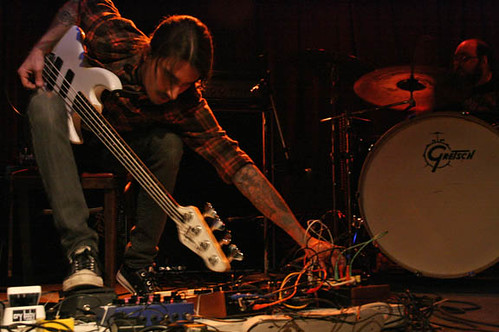
Pole Position: Live, Varallyay improvises most of Stymphalian Birds’ music by running a bass and a steel pole—used as percussion—through foot pedals to create bizarre electro-acoustic ambiances on the fly. “I have a vocabulary, and I bring what I can to the table,” he says. “Sometimes I have things in my mind, [riffs] that I’ve done before, but all of the arrangements are spontaneous.” Still, Varallyay is a little self-conscious about getting too deep into improv rhetoric. “I don’t want to over-intellectualize it,” he says. “I just like fucking with stuff.”

Stymphalian Birds plays the Velvet Lounge Tuesday, July 8.